Oregon, Ohio
Furnace Repair Oregon OH
Oregon sits east of Toledo near the lake, and homes here take the brunt of wind-driven cold. When a furnace in Oregon cannot keep up, the first question is whether the equipment is failing or whether it is simply running constantly against heat loss — and that distinction is something a diagnosis answers quickly.
Call now for a FREE QUOTE and for service availability. Please have your 5-digit ZIP code ready.
- Residential furnace repair only
- 24/7 service availability
- Availability confirmed by ZIP code
Furnaces in Oregon homes
Many Oregon homes are postwar ranches and split levels with gas furnaces in the basement or a utility area off the garage. Garage-adjacent installations can pull in cold air, which affects how the furnace behaves on the coldest days.
Proximity to the lake means damp winters. Moisture, rust at the base of a furnace cabinet and condensate handling come up more often in this part of the area.
Older neighborhoods near Navarre and Wynn Road often still run 80% efficiency furnaces vented into a masonry chimney, where draft problems can show up as a furnace that starts and then shuts down.
Typical equipment here: Postwar ranches, split levels and older chimney-vented gas furnaces near the lake.
Older Oregon systems and chimney venting
Oregon has a deep stock of postwar and mid-century homes where the original heating layout is still largely intact. Many of those furnaces are conventional 80% efficiency units venting into a masonry chimney, often alongside a gas water heater. On the coldest mornings a marginal flue can be slow to establish draft, the pressure switch does not close, and the furnace makes several ignition attempts before locking out. Homeowners see a furnace that starts, hums, then gives up.
Venting problems are not something to troubleshoot from inside the house. If a furnace repeatedly fails to light, if a carbon monoxide alarm sounds, or if there is a sharp exhaust smell near the equipment, the right move is to shut the furnace off at its service switch and call. Combustion and draft checks require instruments.
Garage-adjacent equipment, airflow and damp winters
A fair number of Oregon homes place the furnace in or beside an attached garage or a utility space on an exterior wall. Those locations run colder, and cold matters: condensate lines on high-efficiency units can freeze, sidewall exhaust terminations can ice over during a lake-effect stretch, and a furnace in an unconditioned space works against ambient loss before it heats anything.
Damp winter conditions near the lake also affect airflow components. Filters loaded with moisture-laden dust restrict sooner, blower wheels collect a film that throws them out of balance, and evaporator coils in a shared cabinet can restrict return air enough to trip the limit. When the complaint is warm air but very little of it, the diagnosis order is usually filter, blower wheel condition, coil restriction, then duct issues — measured, not assumed.
Safe checks before you call
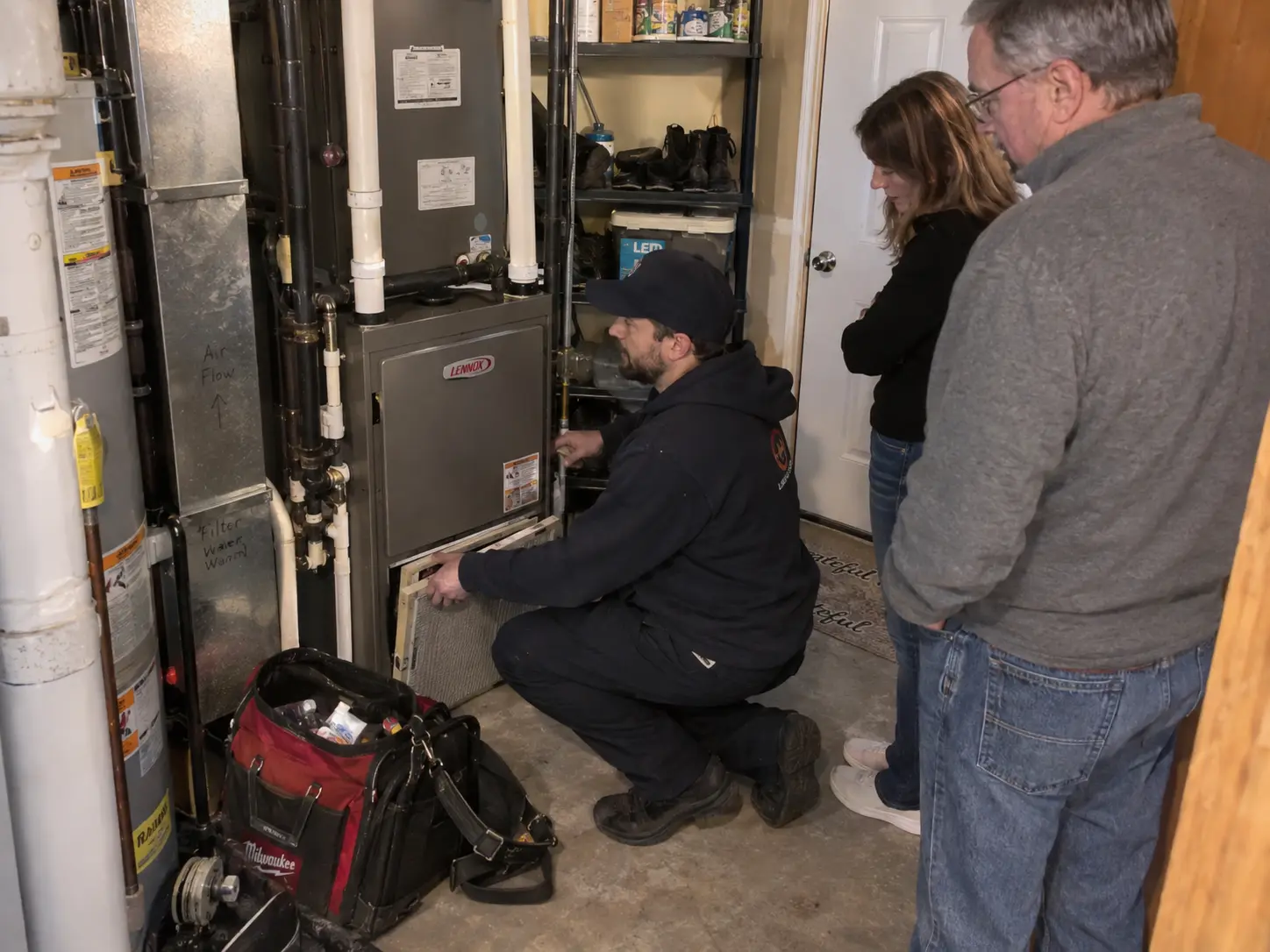
Confirm the thermostat is set to HEAT and several degrees above room temperature. Check the furnace service switch and the breaker. Pull the filter and replace it if it is loaded. Make sure supply registers and return grilles are open. Note any flashing diagnostic light on the furnace. Stop there — anything involving gas components or line-voltage wiring belongs to a technician.
Safety first: gas odor and carbon monoxide
If you smell natural gas or rotten eggs
- Leave the home immediately.
- Do not operate electrical switches, appliances or garage door openers.
- From a safe location away from the house, contact your gas utility or emergency services.
If a carbon monoxide alarm activates
- Leave the home.
- Follow the alarm manufacturer's instructions and the direction of emergency authorities.
- Do not re-enter until you are told it is safe.
Never attempt gas piping, gas valve or line-voltage repairs yourself.
Furnace repair questions from Oregon homeowners
My Oregon furnace runs constantly on cold days. Is something wrong?
Long run times in severe cold are normal for a correctly sized furnace. Constant running combined with falling indoor temperature, weak airflow or cool supply air is different and worth a diagnosis.
There is rust at the bottom of my furnace. Does that mean replacement?
Not automatically. Surface rust can come from condensate, a humidifier or a nearby leak. A technician looks at where the moisture originates before anything is called a failure.
What ZIP codes in Oregon do you cover?
Service availability is confirmed by ZIP code when you call. Have your 5-digit ZIP ready and dial 419-517-4547.
Keep reading
Helpful pages
Related guide
Banging, Clicking, Buzzing or Squealing Furnace? What the Noise May MeanSound is a clue, not a diagnosis. Here is what each common furnace noise may point toward — and which ones justify shutting the system off.
Furnace trouble in Oregon?
Call 419-517-4547 and describe what the furnace is doing. Service availability in Oregon is confirmed by your 5-digit ZIP code.
Call now for a FREE QUOTE and for service availability. Please have your 5-digit ZIP code ready.