The Homeowner's Furnace Guide
You do not need to be a technician to understand your furnace. You just need to know the order things happen in — because when heat stops, the failure is almost always at one specific step in that sequence.
The heating sequence, start to finish
A modern gas furnace does not simply turn on. It runs a supervised sequence, and it will refuse to continue if any step cannot be verified.
- The thermostat calls for heat. Room temperature drops below the setpoint and a low-voltage signal goes to the furnace control board.
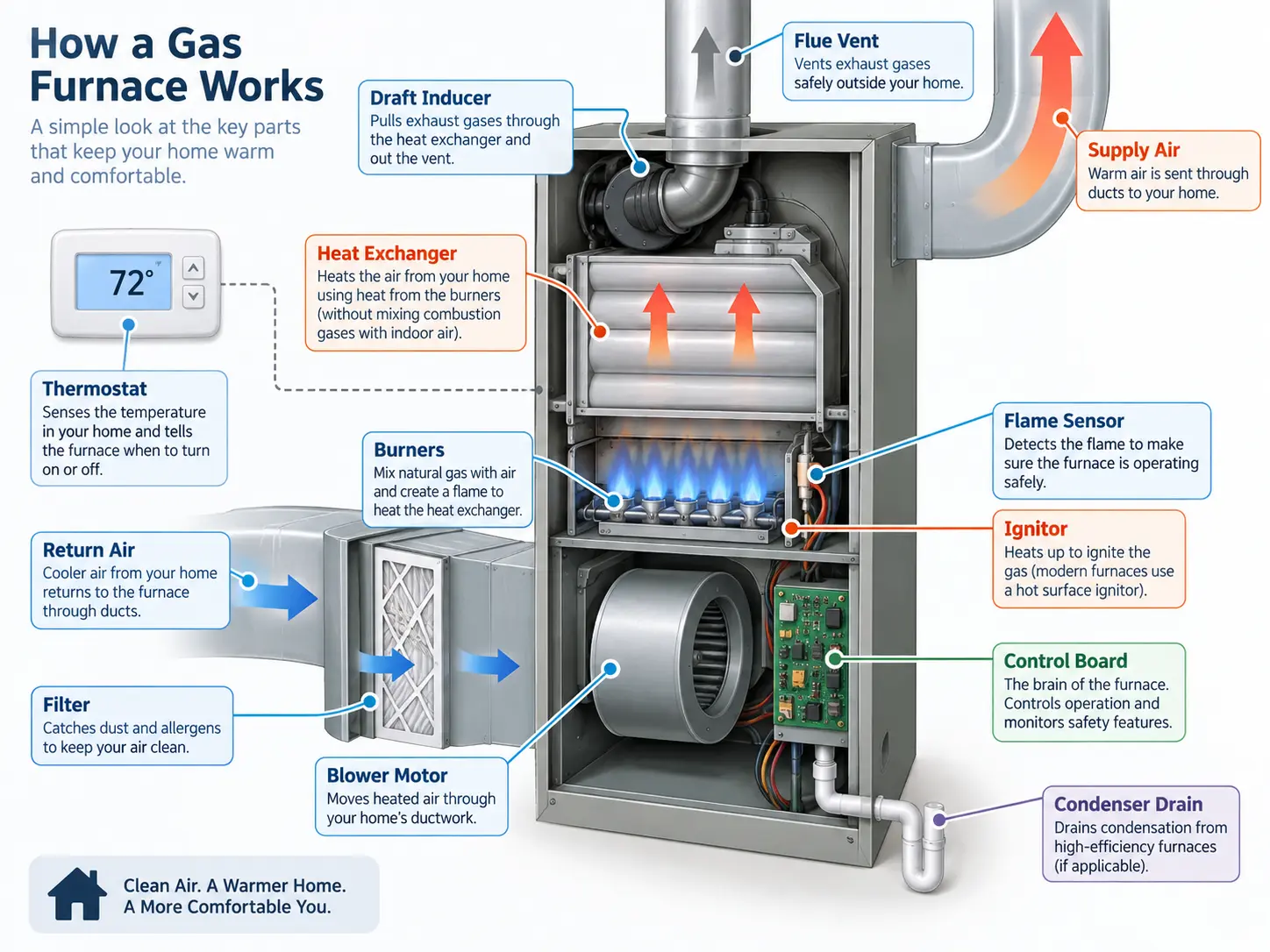
- The draft inducer starts. This small fan pulls combustion gases through the heat exchanger and out the vent, clearing the chamber before any gas flows.
- The pressure switch proves draft. If the inducer is not moving air properly — because of a blocked vent, a failing motor or a plugged condensate line — the switch stays open and the sequence stops right here.
- The ignitor heats. A hot surface ignitor glows bright orange. Older systems may use a spark or a standing pilot.
- The gas valve opens and burners light. Gas mixes with air and ignites across the burner assembly.
- The flame sensor proves flame. Within a few seconds the sensor must confirm a flame is actually present. If it cannot, the board shuts the gas off — which is exactly why a dirty sensor produces the classic "lights for five seconds then quits" symptom.
- The blower starts. After a short delay so the heat exchanger warms, the blower moves house air across the exchanger and out to the supply registers.
- Limit switches watch the whole time. If the furnace gets too hot — usually from restricted airflow — a limit switch shuts the burners down while the blower keeps running to cool things off.
Read that list again with your symptom in mind and you can usually tell roughly where in the sequence your furnace is stopping. That is genuinely useful information to give us on the phone.
Gas, electric and high-efficiency furnaces
Conventional gas furnaces (often around 80% efficiency) vent through a metal flue or masonry chimney. Their common failures cluster around ignition components, draft, flame sensing and blower parts.
High-efficiency condensing furnaces extract so much heat from the exhaust that water condenses out of it. They vent through PVC pipe, usually out a side wall, and they need a working condensate trap and drain. Blocked drains and blocked or snow-covered vent terminations are a whole failure category that conventional furnaces simply do not have.
Electric furnaces have no burners, no flame sensor and no venting. Their failures involve heating elements, sequencers, limits, contactors and the blower. They also draw significant current, so breaker and wiring issues matter more.
Propane furnaces operate like natural gas units but with different orifices and pressures. Telling us the fuel type saves time.
Every major component, explained
What it does, what it looks like when it goes wrong, and how far a homeowner should reasonably go.
Thermostat
- What it does:
- Senses room temperature and tells the furnace when to start and stop a heating cycle.
- Symptom when something is wrong:
- Blank display, no response to changes, short cycling, or the furnace ignoring the schedule.
- Homeowner inspection:
- Yes — check the mode, setpoint and batteries, and make sure nothing is blowing on it.
- When to stop:
- Stop before removing the thermostat from its base or touching the wiring.
Air filter
- What it does:
- Captures dust and debris before air passes into the blower and heat exchanger.
- Symptom when something is wrong:
- Weak airflow, short cycling, overheating, higher bills, a dusty or burning smell.
- Homeowner inspection:
- Yes — inspecting and replacing the filter is a normal homeowner task.
- When to stop:
- Stop if the filter slot is inside a sealed cabinet you would need tools to open beyond the standard door.
Ignitor
- What it does:
- On most modern gas furnaces this is a hot surface ignitor that glows and lights the burners. Older units may use a pilot or spark system.
- Symptom when something is wrong:
- Clicking or inducer running with no flame, or repeated failed start attempts.
- Homeowner inspection:
- No — visual observation only if the sight glass allows it.
- When to stop:
- Stop before removing or handling the ignitor. They are brittle and carry line voltage.
Burners
- What it does:
- Mix gas with air and produce the flame that heats the heat exchanger.
- Symptom when something is wrong:
- Uneven or yellow flame, delayed ignition with a bang, rumbling, or flames that roll out.
- Homeowner inspection:
- No — observation through the sight window only, panels closed.
- When to stop:
- Stop immediately if flames appear outside the burner compartment. Shut the furnace off and call.
Flame sensor
- What it does:
- Confirms to the control board that a flame is actually present. Without that signal, gas is shut off within seconds.
- Symptom when something is wrong:
- Burners light for a few seconds then go out, often repeating several times.
- Homeowner inspection:
- No — the sensor sits in the flame path and is easily damaged.
- When to stop:
- Stop at the symptom. Cleaning and testing a flame sensor is technician work.
Heat exchanger
- What it does:
- Transfers heat from combustion into the air moving through the furnace while keeping combustion gases separate from indoor air.
- Symptom when something is wrong:
- Unusual odors, soot, flames disturbed by the blower, or a furnace repeatedly tripping a limit.
- Homeowner inspection:
- No.
- When to stop:
- This is a safety-critical component. Any suspicion should be evaluated professionally, not by a homeowner.
Blower motor
- What it does:
- Moves air through the furnace, the ductwork and back through the return.
- Symptom when something is wrong:
- Squealing, weak airflow, a blower that will not start, or one that never stops.
- Homeowner inspection:
- No beyond noting the sound and airflow.
- When to stop:
- Stop before opening the blower compartment. Capacitors can hold a charge.
Control board
- What it does:
- Runs the ignition sequence, monitors safety devices and stores diagnostic codes on a small LED.
- Symptom when something is wrong:
- No response, erratic behavior, a blinking fault code, or a blown low-voltage fuse.
- Homeowner inspection:
- Yes for reading a visible flashing LED code through the sight window.
- When to stop:
- Stop at reading the code. Do not reset repeatedly or probe the board.
Limit switch
- What it does:
- Shuts the burners off if the furnace gets hotter than its design allows.
- Symptom when something is wrong:
- Furnace heats briefly then stops, often with the blower continuing to run.
- Homeowner inspection:
- Indirectly — restoring airflow by replacing a loaded filter can prevent nuisance trips.
- When to stop:
- Never bypass or jumper a limit switch. It exists to prevent an overheat condition.
Pressure switch
- What it does:
- Verifies that the draft inducer is moving combustion gases before allowing ignition.
- Symptom when something is wrong:
- Inducer runs, then the furnace stops without lighting. Often paired with a specific flash code.
- Homeowner inspection:
- Partly — clearing snow, leaves or debris from outdoor vent terminations is reasonable.
- When to stop:
- Stop before touching the switch or its tubing.
Draft inducer
- What it does:
- Pulls combustion gases through the heat exchanger and out the vent.
- Symptom when something is wrong:
- A loud hum or rattle at startup, or no inducer sound at all before ignition.
- Homeowner inspection:
- No beyond noting whether you hear it run.
- When to stop:
- Stop at observation.
Gas valve
- What it does:
- Controls the flow of gas to the burners under the direction of the control board.
- Symptom when something is wrong:
- No gas flow despite a working ignitor, or a furnace that will not stay lit.
- Homeowner inspection:
- No.
- When to stop:
- Never attempt to adjust, bypass or manually open a gas valve. This is qualified HVAC technician work.
Return air
- What it does:
- Carries cooler indoor air back to the furnace to be reheated.
- Symptom when something is wrong:
- Weak airflow, whistling at return grilles, or a furnace that overheats.
- Homeowner inspection:
- Yes — keep return grilles clear of furniture, rugs and boxes.
- When to stop:
- Stop before opening sealed duct sections.
Supply air
- What it does:
- Distributes heated air through the ductwork to the rooms.
- Symptom when something is wrong:
- Uneven room temperatures, weak delivery in distant rooms.
- Homeowner inspection:
- Yes — open supply registers throughout the home.
- When to stop:
- Stop before adjusting dampers you do not understand; unbalanced dampers can cause new problems.
Condensate drain (high-efficiency furnaces)
- What it does:
- Carries away the water produced when a condensing furnace extracts extra heat from exhaust gases.
- Symptom when something is wrong:
- Water around the furnace, a gurgling sound, or a furnace that locks out on a pressure switch fault.
- Homeowner inspection:
- Partly — noticing and reporting standing water is useful.
- When to stop:
- Stop before disassembling the trap or drain assembly.
What homeowners can safely maintain
The filter is the big one. Checking it monthly during heating season and replacing it when it looks loaded prevents a meaningful share of overheating, limit trips and short cycling calls. Beyond that: keep supply registers and return grilles clear, keep the area around the furnace free of stored items, keep exterior vent terminations clear of snow and debris, and replace thermostat batteries before winter.
That is the full homeowner list. Burner cleaning, flame sensor service, capacitor testing, gas pressure adjustment and anything requiring panels off with power on are technician work — not because it is secret, but because the failure modes are gas and electrical.
Where to go from here
Match what you are seeing against the furnace problems index, get an educational planning range from the cost calculator, or read through the FAQ. If the furnace is out right now, call 419-517-4547.
Safety first: gas odor and carbon monoxide
If you smell natural gas or rotten eggs
- Leave the home immediately.
- Do not operate electrical switches, appliances or garage door openers.
- From a safe location away from the house, contact your gas utility or emergency services.
If a carbon monoxide alarm activates
- Leave the home.
- Follow the alarm manufacturer's instructions and the direction of emergency authorities.
- Do not re-enter until you are told it is safe.
Never attempt gas piping, gas valve or line-voltage repairs yourself.
Talk to someone about your furnace
Describe what the furnace is doing and we will tell you what a diagnosis involves. Residential furnace repair only, with 24/7 service availability.
Call now for a FREE QUOTE and for service availability. Please have your 5-digit ZIP code ready.